Highland Electric Fleets Reports Up to $50 Million in Annual Revenue as School Bus Electrification Grows
This Dad Saw Diesel Exhaust at His Son’s Eye Level. His Bus Electrification Company Now Brings In Up to $50 Million a Year.
Duncan McIntyre started Highland Electric Fleets after noticing a risk built into an ordinary school commute: the bus exhaust pipe sat about level with his second-grade son’s face. The company he founded in Massachusetts in 2018 now reports annual revenue of $45 million to $50 million. That revenue range gives a sense of the business’s scale, but it doesn’t show how much the company earns after covering vehicles, charging systems, financing and operations.
The health concern is broader than one family’s experience. Most U.S. school buses still run on diesel, which the World Health Organization classifies as a known human carcinogen. Children’s developing lungs are especially vulnerable, according to the World Resources Institute. McIntyre’s point is straightforward: diesel exposure on the school run isn’t inevitable when the equipment and manufacturing capacity for electric fleets already exist. The public-health case may be clear; turning it into a purchase is harder, because districts must weigh that benefit against costs, logistics and the demands of keeping buses in service.
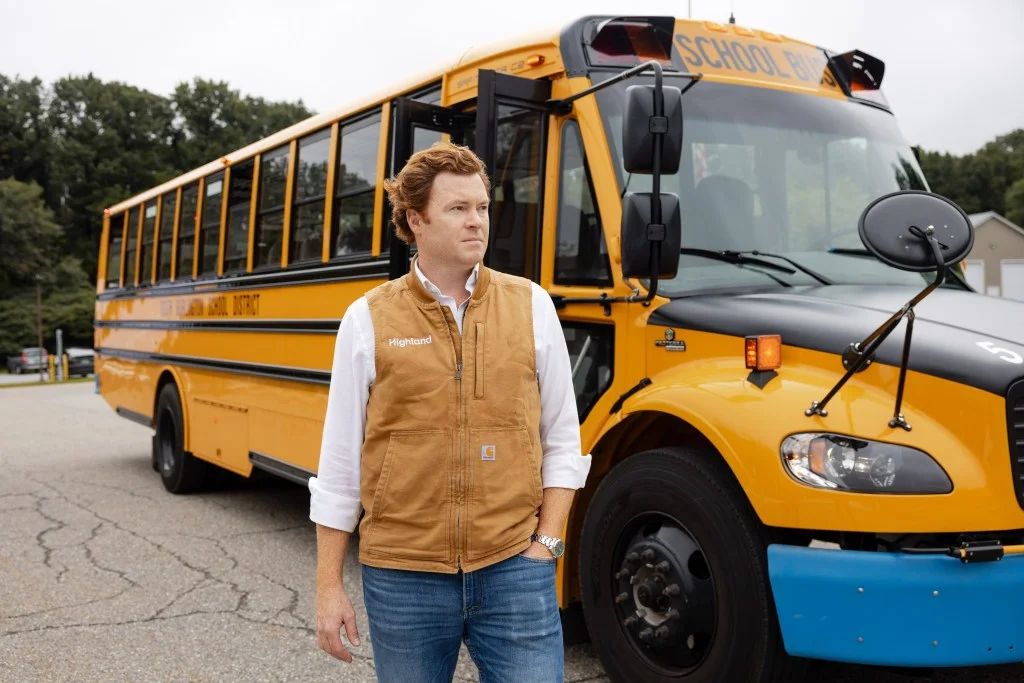
That gap between an available technology and its adoption is where Highland built its business. The company now operates fleets in more than 100 U.S. cities and says it has grown roughly twofold year over year for several years. McIntyre expects another doubling in 2027. The scale is striking, though revenue figures and growth claims here come from the company; they’re not an independent measure of profitability or long-term demand.
Growth claims deserve that distinction. Revenue can rise as a company takes on more projects, while the costs and timing of those projects shape whether the model is financially durable. In fleet electrification, the sale also involves coordinating vehicles with charging and service arrangements. Highland’s expansion therefore says something about demand for its offering, but the company’s figures alone can’t establish how easily other providers could replicate it or how consistently projects perform.
From a school commute to a business
McIntyre brought experience in energy, emissions technology and financing to the problem. Turning that background into a sale took time: Highland spent about a year and a half securing its first project, with the city of Beverly, Massachusetts. He initially financed the company himself, then raised equity to build the business and arranged project financing to purchase equipment and fund deployments. The long path to that first project suggests that a compelling reason to switch doesn’t automatically produce a quick procurement decision.
That financing model points to the harder part of electrifying buses. A district needs more than vehicles: it needs charging infrastructure, trained staff and a plan to fit the investment into a tight budget. Highland says it aims to keep costs at or below those of diesel fleets, and in some locations has saved customers 10% to 20%. Cities pay by the mile once transportation is successfully underway, rather than paying upfront.
For a school system, that structure can change when the cost arrives and who has to arrange the equipment. It doesn’t remove the underlying expense; it packages the project around service delivery and mileage. That can make a proposal easier to consider where a large upfront purchase is a barrier, though each district still has to assess its own routes, facilities and operating requirements. A per-mile arrangement also makes the details of the service agreement consequential: the customer is buying transportation, not simply adding buses to a vehicle inventory.
Charging is another practical constraint. Vehicles and infrastructure have to work together, and staff need to be prepared to operate and maintain the fleet. Similar transitions often depend on matching equipment to local schedules and facilities, so a model that works in one city won’t necessarily transfer unchanged to another. The setup is less visible than the bus itself, but it can determine whether the service fits a district’s day-to-day needs.
Here’s the thing: claims of savings matter most when they’re tied to the specific places where Highland has achieved them. The company’s reported 10% to 20% savings in some locations is relevant, but it doesn’t establish that every district will see the same result. Local costs and operating needs differ, and the article doesn’t provide enough detail to compare those projects. (And this is the part most people overlook.)
Growth, scale and the next test
McIntyre says Highland is targeting fleets in 200 cities over the next 12 months and will sponsor the 2028 Olympics in Los Angeles. Those ambitions suggest the company sees electric buses moving into mainstream use. The open question is how quickly cities can convert fleets when each project depends on local infrastructure, financing and operating needs. A target is a sign of intent, not a completed rollout.
For the business, expansion will test whether its project financing and operating approach can support more cities while accounting for different local conditions. For districts, the relevant question is whether the arrangement can meet transportation needs without creating new operational burdens. If you’re working in this space, the distinction between interest and deployment is the one to watch: interest can grow quickly, while each conversion still has to be planned and put into service.
This is more significant than it looks. School buses are familiar, routine vehicles, and changing them means working within an essential public service rather than introducing a technology that customers can simply choose to use less often. That makes reliability and fit central to adoption. And yet, the reported business growth shows that at least some cities are willing to test a different model for getting buses on the road.
Whether Highland can meet its expansion goals will depend on more than the health argument that first drew McIntyre’s attention. The company will need to keep matching financing, vehicles, charging and local operations as it enters more cities. The article offers evidence of an expanding business and a service model designed around district budgets; it doesn’t settle how broadly the reported savings will apply or whether the recent pace of growth can continue. Still, the underlying problem is easy to understand: children ride these buses every day, and districts have to decide how to address the trade-offs in the fleets they run.
About the author
Amanda Breen is a senior features writer at Entrepreneur.com and an Entrepreneur staff member. She graduated from Barnard, though the biography provided here is truncated and doesn’t supply further background. You can connect with her on LinkedIn.