Beer Excise Taxes in Europe: Finland Charges Nearly 19 Times Bulgaria’s Rate
Beer taxes vary sharply across Europe
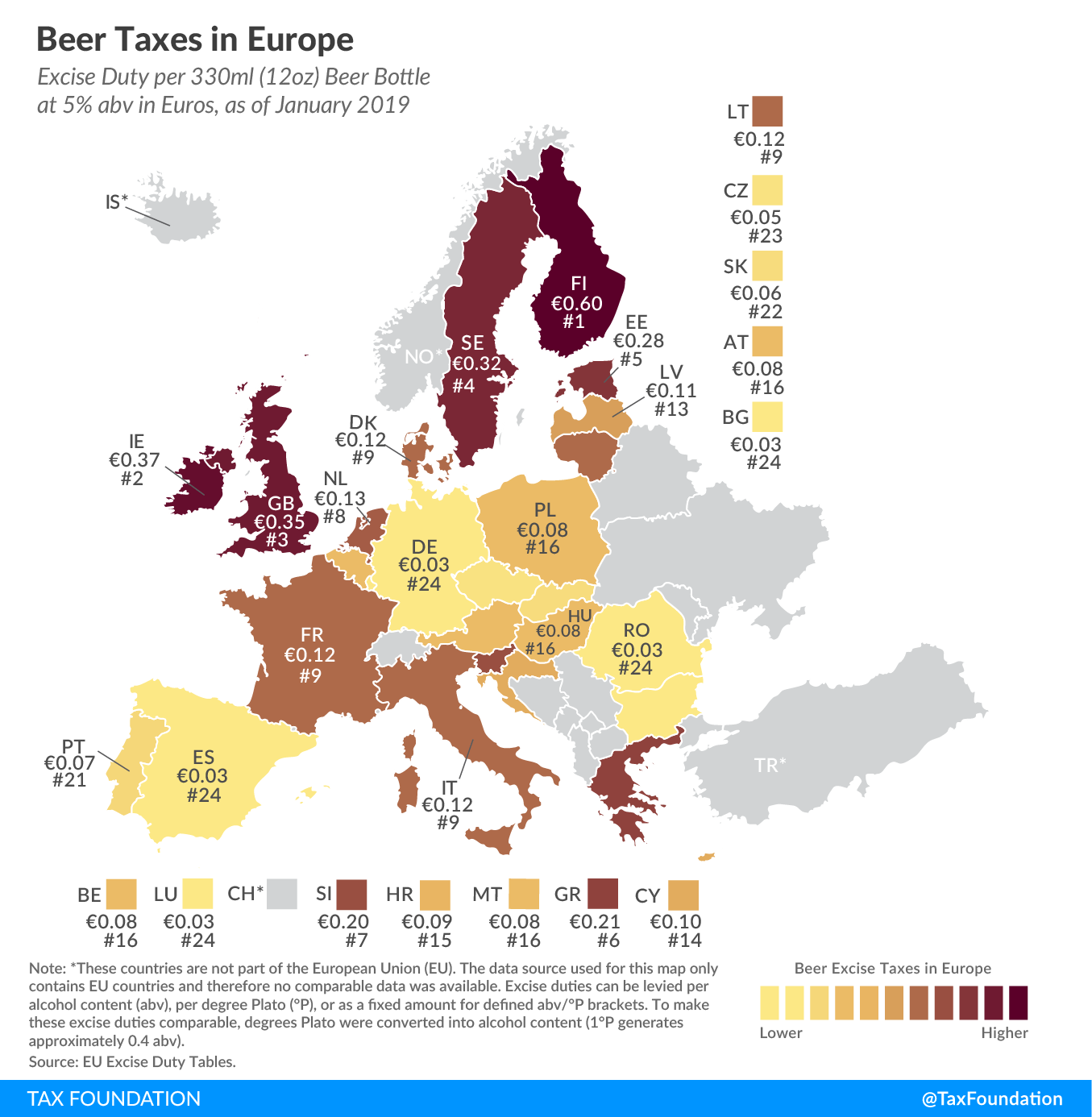
Oktoberfest season offers a useful reminder that the price of a beer depends partly on where it’s sold. Across Europe, excise duties on a standard bottle differ dramatically: Finland charges €0.6057 per 330 mL bottle of 5% ABV beer, while Bulgaria charges €0.0318. That gap is more significant than it may look; it reflects how differently governments tax alcohol. EU rules set a minimum beer excise duty of €1.87 per 100 liters per degree of alcohol. Applied to a 330 mL bottle at 5% ABV, that comes to about €0.0309 ($0.0364). Few member states stay close to the floor. The United Kingdom, which is included in the comparison, charges €0.4341 per bottle, and Ireland €0.3721. Germany and Luxembourg are also near the minimum, at €0.0326 each. The source describes the UK as second-highest, though its table ranks it second among the listed jurisdictions. The comparison requires some care. Countries calculate beer duty in different ways: by alcohol content, by degrees Plato, or through fixed rates for defined alcohol or Plato ranges. The figures convert those systems to euros for a common 330 mL, 5% ABV bottle; the table note says one degree Plato is treated as approximately 0.4 ABV. VAT is separate, charged as a percentage of the sales price, and excluded from the map. The table lists additional VAT rates from 17% in Luxembourg to 27% in Hungary. The EU’s [minimum-duty rules](https://taxation-customs.ec.europa.eu/taxation/excise-duties/excise-duties-alcohol_en) establish a baseline, but national choices account for most of the spread. That fits the broader [variation in alcohol tax policy around the world](https://taxfoundation.org/research/all/global/global-excise-tax-policy-application-trends/). If you’re comparing shelf prices across borders, excise duty is only one part of the picture: the separate [VAT rates](https://taxfoundation.org/data/all/eu/value-added-tax-vat-rates-europe/) also vary. Among the 2026 figures, [Finland](https://taxfoundation.org/location/finland/) leads at €0.6057 ($0.700) per bottle, followed by the [United Kingdom](https://taxfoundation.org/location/united-kingdom/) at €0.4341 ($0.501) and [Ireland](https://taxfoundation.org/location/ireland/) at €0.3721 ($0.430). [Bulgaria](https://taxfoundation.org/location/bulgaria/) is lowest at €0.0318 ($0.0367), with [Germany](https://taxfoundation.org/location/germany/) and [Luxembourg](https://taxfoundation.org/location/luxembourg/) next at €0.0326 ($0.0377). The table covers EU member states and the UK, as of July 2026. Data compiled by [Adam Hoffer](https://taxfoundation.org/about-us/staff/adam-hoffer/) and [Jacob Macumber-Rosin](https://taxfoundation.org/about-us/staff/jacob-macumber-rosin/).Beer excise duties in Europe
The gap between the highest and lowest beer duties is striking: a 330 mL bottle of 5% beer carries an excise tax of €0.5973 in Finland, compared with €0.0316 in Bulgaria. That’s nearly a nineteenfold difference, though the figures measure excise duty alone and don’t capture the full shelf price. Ireland ranks third at €0.3721, Sweden fourth at €0.3247, and Estonia fifth at €0.2310. The United Kingdom is second, at €0.4187. At the other end, Germany charges €0.0325 and Spain €0.0329; Luxembourg is close behind at €0.0327. The spread makes clear that “beer tax in Europe” isn’t one policy. National rates differ sharply even for the same standard serving. The table compares duties on 330 mL of beer at 5% alcohol by volume across 28 countries. Excise systems may calculate tax by alcohol content, degrees Plato, or fixed bands for specified strength ranges. To make the results comparable, the underlying figures convert degrees Plato using an approximate relationship of 1°P to 0.4% ABV. That conversion helps, but the comparison still reflects a standardized example rather than every beer or tax arrangement.What changed in 2026
Lithuania made the largest listed increase, adding €0.0292 to the duty on a standard beer bottle. Estonia raised it by €0.0231, Sweden by €0.0162, the UK by €0.0155, and Latvia by €0.0129. Other countries recorded changes of less than one eurocent, whether through rate adjustments or updated currency conversions. Those increases are small in absolute terms, but the cross-country rankings show why they can matter for producers and retailers tracking several markets. The data doesn’t explain what drove each government’s decision, and the duty alone can’t tell you how much consumers ultimately pay. Excise taxes serve two purposes: raising revenue and discouraging alcohol consumption. As a tool for reducing alcohol-related harm, though, a uniform tax on beer is blunt. European governments also tax wine and spirits differently: beer generally faces higher duties than wine, while spirits are taxed more heavily than beer. Some countries impose no excise duty on wine. The categories themselves are getting harder to police cleanly. Craft beers span a wider range of strengths, malt liquor pushes beer toward higher alcohol content, and ready-to-drink cocktails can end up with alcohol levels closer to beer than to straight spirits. If you’re assessing how these taxes shape the market, the product labels matter less than the rules used to classify and tax what’s in the bottle.Source: European Commission Taxation and Customs Union; UK HM Revenue & Customs. Data compiled by Adam Hoffer and Jacob Macumber-Rosin.
Related comparisons: wine taxes in Europe, distilled spirits taxes in Europe, and analysis of alcohol tax modernization and ABV-based taxation.
Historical data and graphics:
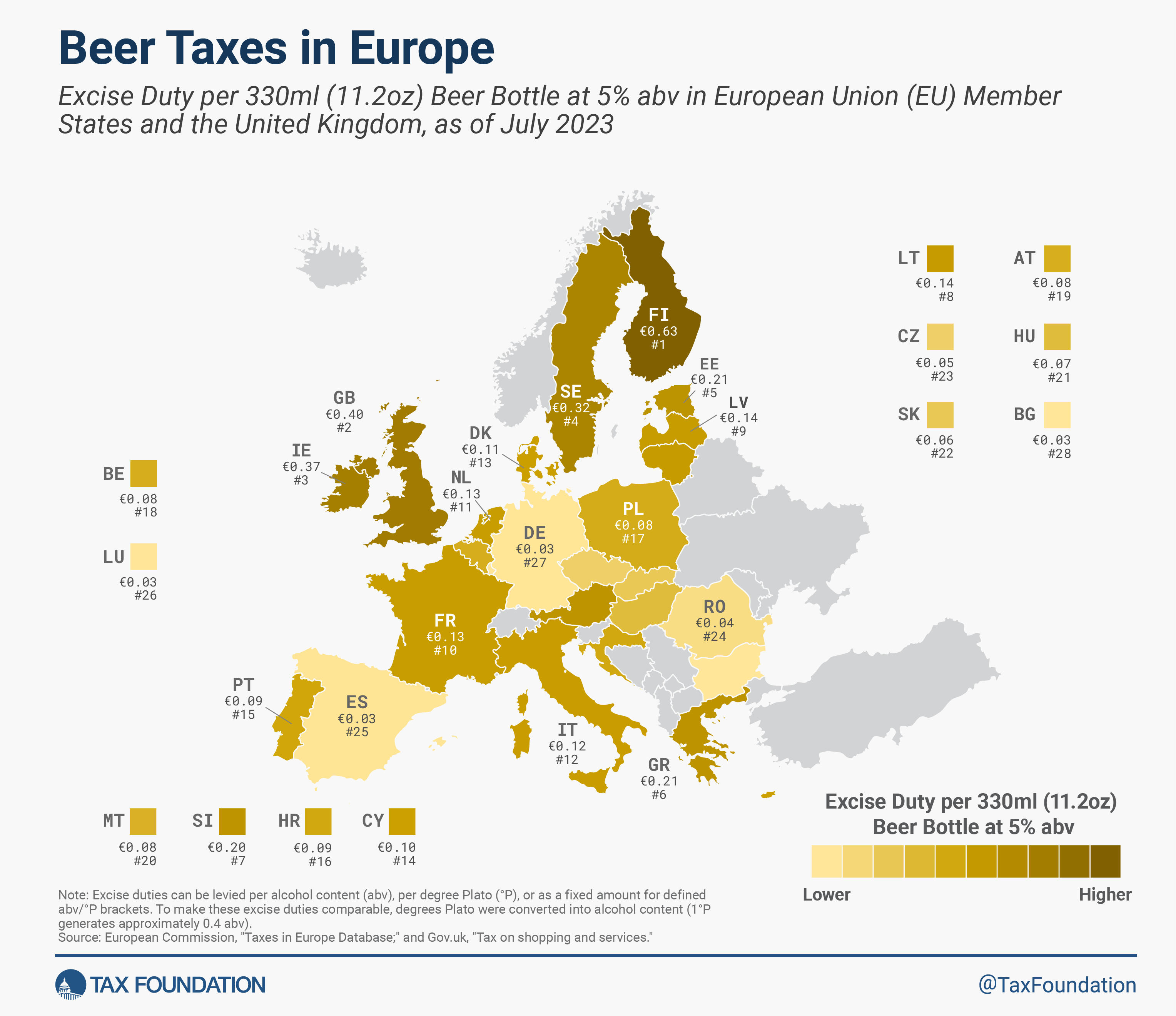
Data compiled by Alex Mengden. See prior analysis
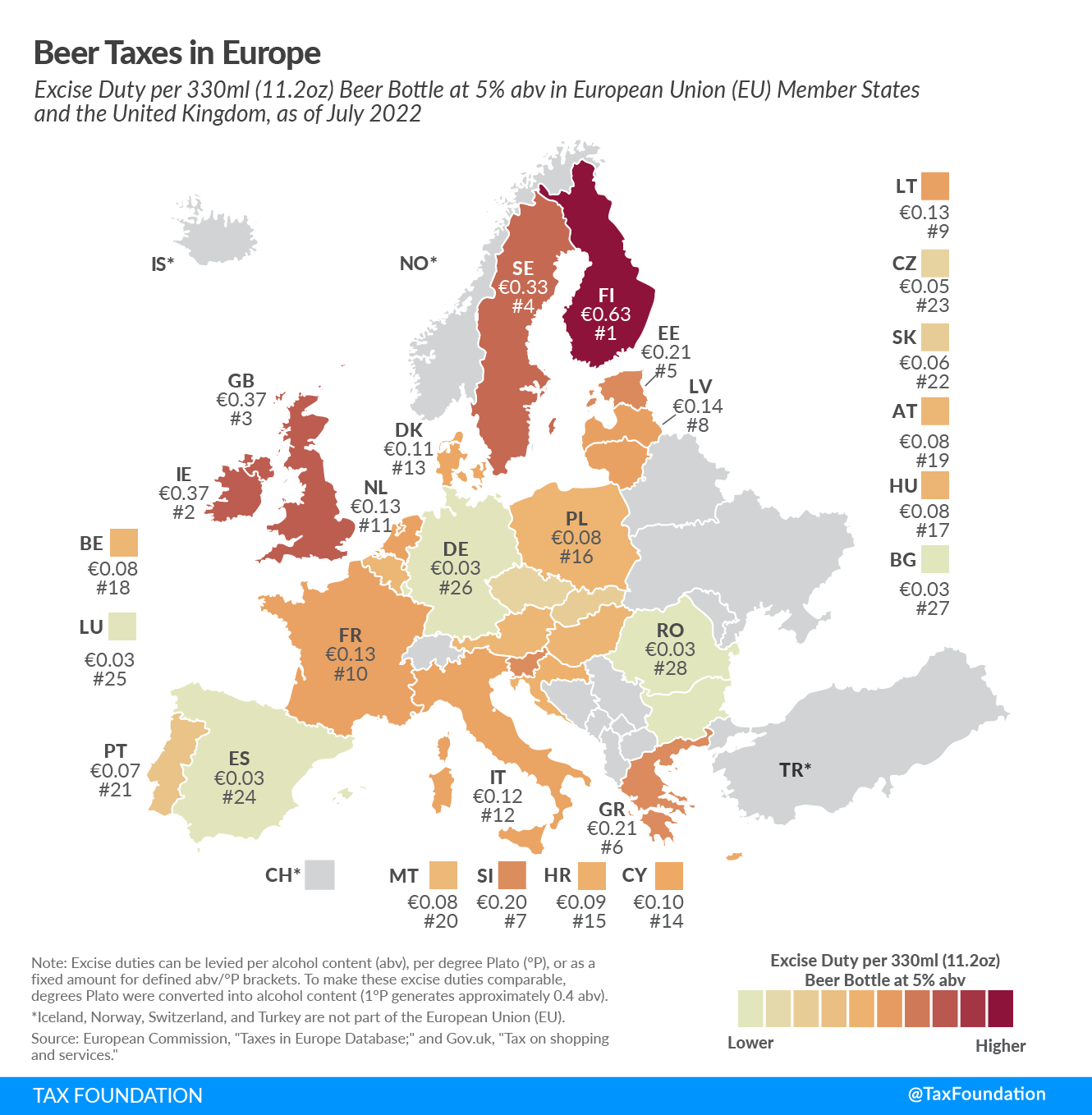
Data compiled by Adam Hoffer. See prior analysis
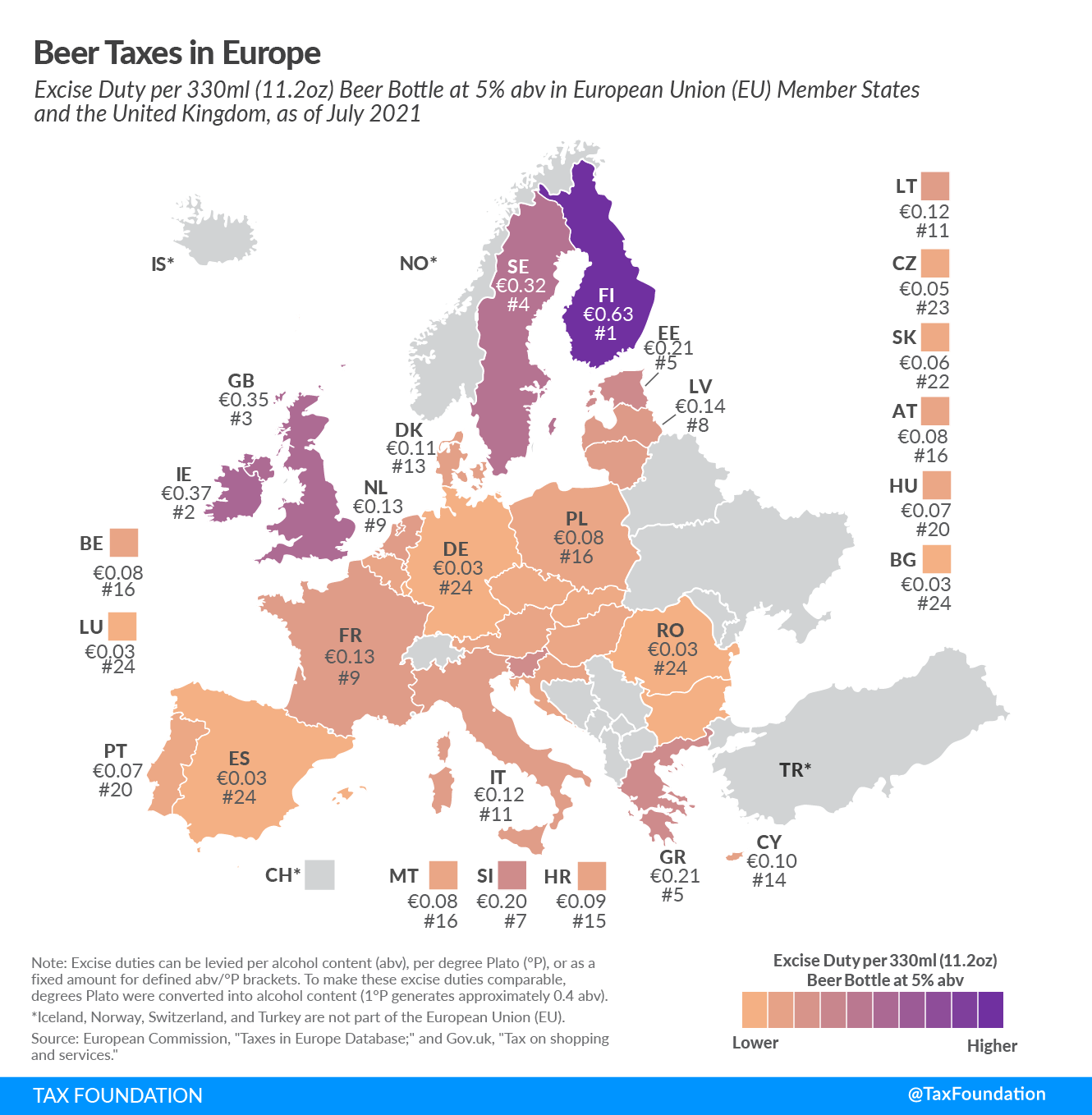
Data compiled by Elke Asen. See prior analysis
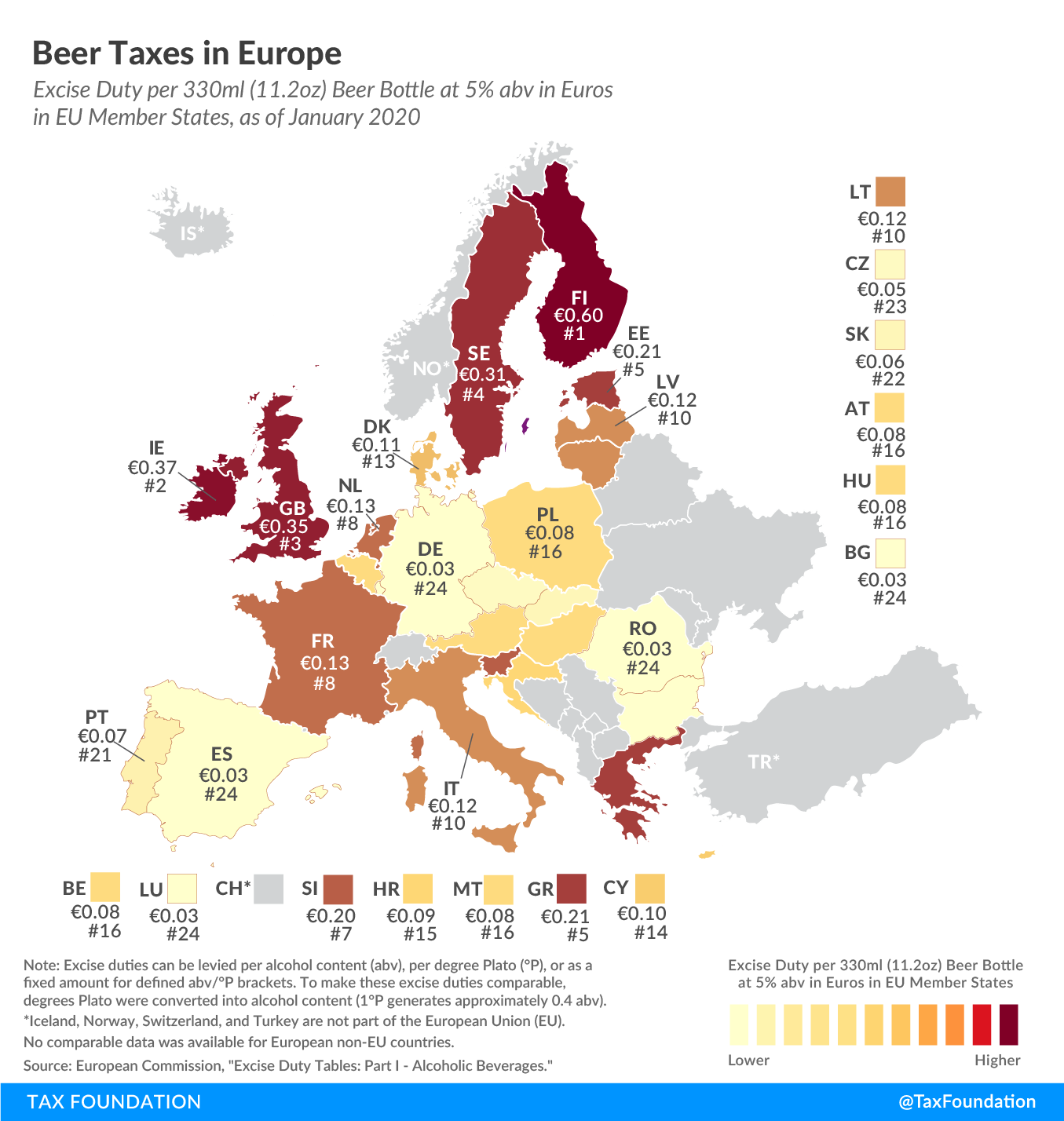
Data compiled by Elke Asen. See prior analysis
Data compiled by Elke Asen. See prior analysis
A simpler tax base, with trade-offs
The case for taxing alcohol by its strength is straightforward: it could make rates more consistent across drink categories and reduce the paperwork created by rules built around product labels. That matters as new kinds of alcohol products make category-based systems harder to administer. But the change would also reflect a policy choice. European governments set different beer tax rates per degree of alcohol, balancing revenue goals with public health and efforts to influence what people drink.
The systems vary. EU countries generally tax beer according to its alcohol content or degree Plato, while other alcohol categories may follow different rules. The United Kingdom’s duties apply similar or uniform rates by alcohol content across most product categories. A common alcohol-content basis could make treatment clearer and more even, though the fragment doesn’t establish how governments would set rates or manage the transition. The administrative gains are plausible; the fiscal and behavioral effects would depend on those choices.
Help Us Improve TaxFoundation.org
Your feedback helps us make our research easier to find and use.
Share Your Feedback