Fragment Tests AI Agent Reliability for Enterprise Procurement Work
For enterprise AI, the commercial test is shifting from whether an agent can finish a task in a demo to whether a company can trust it with live operations. Fragment is applying that test to procurement, where agents may handle workflows tied to real purchases and financial commitments. Founding engineer Charlie Tang leads work to evaluate the systems before customers rely on them.
That focus reflects a practical constraint on adoption: businesses need evidence about how an agent behaves when the data is messy, a workflow takes an unexpected turn, or a decision carries consequences beyond the immediate task. Fragment’s approach uses simulated environments built from production data to expose weaknesses before deployment. The company’s challenge is to make those simulations representative enough to inform decisions about reliability.
Procurement puts reliability in focus
Procurement supports the flow of goods and materials through large companies, but many of its workflows remain manual and repetitive. Fragment is building AI agents to automate parts of that work. The potential efficiency gain is clear, but so is the execution risk: an agent that mishandles a request or responds poorly to an unusual situation can create a costly error.
That makes procurement a demanding setting for autonomous software. Success on a limited set of routine tasks doesn’t establish that an agent can manage the varied conditions found in corporate operations. A system may appear capable in a controlled demonstration and still behave unpredictably when the inputs, context, or sequence of steps changes.
For Tang, evaluation is therefore part of the product work, not simply a final quality check. His team tests agents in simulated environments based on real production data, examining how they perform across realistic business scenarios. The aim is to find failure modes early, understand where a system’s limits lie, and improve its behavior before it handles customer work.
Using production data helps the simulations reflect the complexity of actual workflows. It gives the team a way to assess how an agent responds to business conditions that may not have appeared in training or in a narrow demonstration. The method doesn’t make every possible failure predictable, but it can give the company a more grounded basis for judging performance before deployment.
The distinction matters commercially. A capable agent that cannot be trusted with purchases, goods, or money may have little practical value to an enterprise. Fragment’s work addresses a hurdle between experimentation and operational use: showing that an agent can perform across realistic conditions, and identifying the situations where it still needs improvement.
From mathematical puzzles to trading
Tang’s path to this engineering problem began with abstract challenges. He grew up in the Netherlands and competed in mathematics during high school. He placed fourth in the 2019 Dutch Mathematical Olympiad and earned a bronze medal at the 2020 Benelux Mathematical Olympiad.
At Utrecht University, he completed degrees in mathematics and physics in three years, graduating with honours in mathematics. That training gave him experience working through complex problems, though his next role introduced a different kind of pressure: decisions had to be made quickly, with uncertain outcomes.
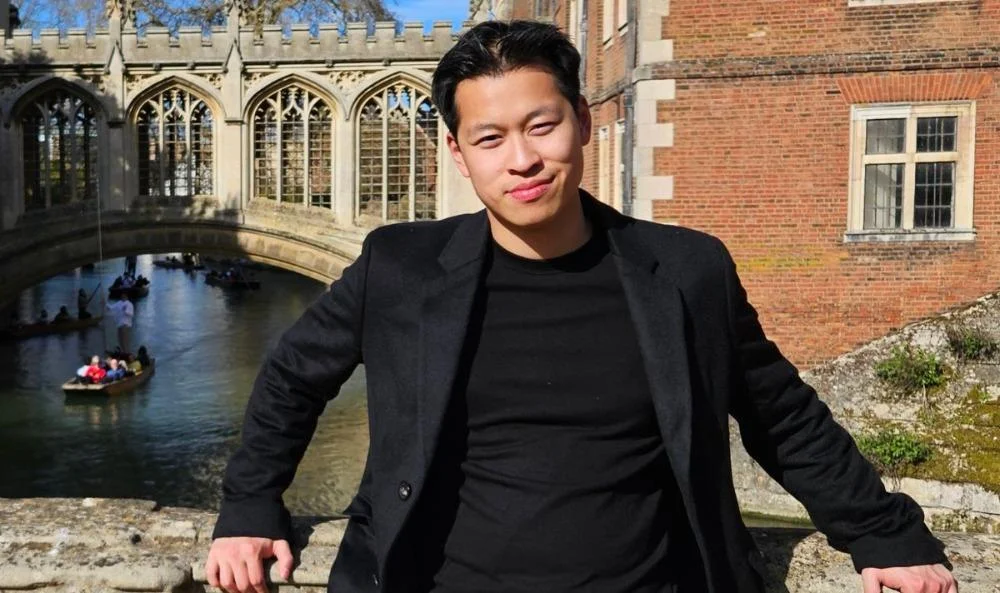
In his second year at university, Tang applied for a summer internship at Optiver, a selective trading firm, and was accepted. He liked the work and returned full-time at the end of 2023 as a trader in the firm’s Amsterdam office. He describes the environment as demanding, with a need to adapt and keep learning.
He says the role taught him to take ownership of the business and make decisions without certainty about the result. Those lessons later informed how he approached engineering work in AI, where a system’s apparent ability can differ from its reliability in changing conditions.
A deliberate move into applied AI
By early 2026, Tang was looking for a new challenge. AI had moved beyond the chatbot use cases that had defined much of the public conversation a few years earlier; coding agents could now write and ship software. He saw a broader shift toward systems that carry out tasks, and wanted to work on agents with consequences in business operations.
Leaving Optiver meant giving up a prestigious role and a clear career path. Tang decided the pace of AI development made the opportunity worth pursuing, and resigned before he had another job lined up. The decision came before he had settled on the specific problem he wanted to tackle.
He found that problem at Fragment, a San Francisco-based applied AI startup building agents for enterprise procurement. The work appealed to him because procurement is central to the movement of physical goods, yet many of its processes still rely on manual effort. Automating those processes, however, requires more than a model that can follow instructions in ideal conditions.
Tang joined as a founding engineer, taking on the question of whether Fragment’s agents could operate dependably in real business environments. The company has raised funding to develop its technology. The source reports a $45 million Series A and says Fragment later emerged from stealth with $56 million in total funding. It reports that 8VC led the Series A; General Catalyst and A* co-led the seed round, and Roelof Botha, former head of Sequoia, is also an investor.
Evaluation as a condition for adoption
AI systems engineering is still a young field, Tang argues, so the people building production systems now have a hand in establishing how the work gets done. His stated ambition is to become a world-class AI engineer and help set standards for how these systems behave. In the near term, his attention is on testing agents against realistic procurement work and helping Fragment expand its platform.
The company plans to develop across source-to-pay workflows and deploy with more large enterprises, according to the source. For buyers, the relevant question will be whether agents can manage those workflows with performance that holds up beyond controlled trials. Evaluation built around real operating data can help answer that question, though trust will depend on what the systems demonstrate in practice.
Tang sees procurement as a starting point for a broader application of AI across industries dealing in physical goods. He imagines agents eventually influencing how products are sourced, made, and moved. That wider ambition depends on the same near-term proof: businesses must see that an agent can handle real goods and real money with enough reliability to earn a role in operations.