Think Jerky Sales Jump After Film Cameo Drives Viral Attention
Think Jerky’s unexpected appearance in a film has translated into a sharp sales increase and a burst of attention the four-person company is now trying to convert into lasting demand. Within two weeks of the cameo, sales of its honey sriracha flavor rose 345% on the company’s website and 92% on Amazon.
For founder and CEO Ricky Hirsch, the episode is an unusually valuable marketing event—but one with a short clock. The brand has roughly 60 days of finished inventory available, while its team works to keep the online conversation active and prepare for possible stock pressure.
A product cameo becomes a sales catalyst
Think Jerky appeared in You Can See Everything, the A24 documentary by Nathan Fielder and Lance Oppenheim. The film features Elizabeth Holmes in the period before she began serving a federal prison sentence. In one scene, Holmes asks for turkey jerky from a prison vending machine. The sequence is reenacted with Amanda Seyfried, who portrayed Holmes in Hulu’s The Dropout; the camera then gives the vending machine a clear view of the product.
The film closes with Holmes and her husband, Billy Evans, eating Think Jerky. The product in the spotlight is the company’s honey sriracha flavor, developed with chef Gale Gand, a Michelin-starred cook and two-time James Beard Award winner.
The appearance wasn’t a planned placement, according to Hirsch. He first heard about it from an employee who had attended a New York screening. At the time, Hirsch was at home in Austin, Texas, watching poker on television. He knew of Holmes and had watched the Hulu series, but says he wasn’t familiar with Fielder.

Hirsch went to see the film himself the following day, taking bags of jerky with him. When the brand appeared on screen, he says, he was overwhelmed by the moment. After the screening, he handed out about 30 bags to people outside the Austin theater.
That small, spontaneous gesture foreshadowed a much wider response. Online users discussed the product as a possible symbol within the film, while others posted videos, created Halloween costumes modeled on the bag, and offered fake merchandise for sale. Restaurants also contacted the company about collaborations. One post on X said H-E-B, the Texas supermarket chain, had sold out of what the poster called “the Elizabeth Holmes jerky.”
Attention reaches beyond the company’s own channels
The sales increase suggests the cameo did more than produce a short-lived burst of social chatter. The company’s website recorded the strongest reported lift, with a 345% rise in honey sriracha sales over two weeks. Amazon sales of the flavor increased 92% over the same period.
Those figures point to demand across two distinct sales channels, though the source provides no revenue, unit-volume, or baseline figures. That makes it difficult to judge the financial size of the jump or how much of it will persist after the film’s attention fades. Still, the spread of discussion across social platforms, video, retail and restaurant inquiries gives Think Jerky several ways to keep the product in view.
Hirsch estimates that buying comparable publicity would have cost millions of dollars. The brand’s name may have helped the moment travel: “Think” Jerky, he says, fits the film’s layered story and gives the bag a role that audiences can interpret for themselves.
That kind of exposure is hard to plan for and harder to repeat. The commercial question now is whether curiosity about a scene can become repeat purchases for a specific flavor. A viral reference can put a product in front of new customers; stock availability and the product itself will determine what happens after the reference stops circulating.
A small team has to turn reach into execution
Hirsch founded Think Jerky in 2015, combining a finance background with an interest in creative branding. The company set out to distinguish itself through minimalist packaging and chef-developed flavors. Its current response to the film is consistent with that positioning: the team is trying to extend the joke and the visual recognition of the bag rather than treat the cameo as a one-off sales event.
That effort is constrained by the company’s size. Think Jerky has four employees and has been bootstrapped, Hirsch says, without raising outside capital. He notes that employees’ partners and other supporters are helping, but the company doesn’t have the staff of a larger consumer brand.
The planned activity includes a trip to the Food & Wine festival in San Diego. Gand is expected to prepare an egg dish topped with jerky, a reference to the film. Think Jerky is also planning lookalike contests, with product giveaways and a cutout of Holmes.
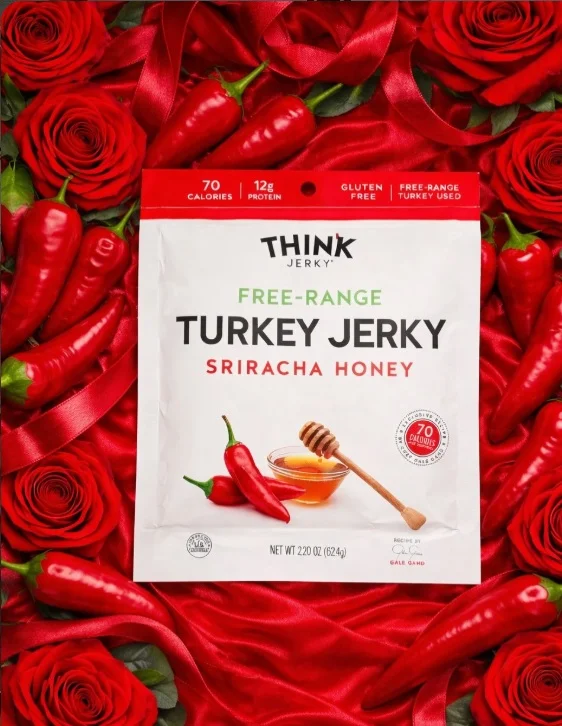
The film’s unusual context has also given the company a distinct label in online conversation. Hirsch says people are already using “Elizabeth Holmes jerky” to describe the product. He recognizes that consumers may not remember the Think Jerky name or logo years from now, but could remember the bag’s appearance in the film. His near-term aim is to make that image shareable and keep the brand part of the discussion.
There’s a trade-off in that strategy. The company can benefit from the film’s cultural moment, but attention tied to a single scene may not automatically build recognition for the broader product line. Its planned events, website work and new releases are attempts to connect the cameo to the company’s chef-led identity.
Inventory and brand work set the next test
Hirsch says sales remain strong and expects the company could sell out. Think Jerky has about 60 days of finished inventory in reserve to address demand. That provides a near-term buffer, but the article offers no production capacity or replenishment timeline, leaving the company’s ability to sustain sales beyond that reserve unclear.
The business is also revamping its website, with completion expected in about a month. Hirsch describes the project as a “soft rebrand” intended to bring the chef-crafted approach into sharper focus. A Thanksgiving turkey stick made with Andrew Zimmern, a four-time James Beard Award winner, is among the products the company plans to launch.
Hirsch is open to raising capital if the right partner emerges. He specifically said he would welcome a conversation with Daniel Lubetzky. For now, the company remains self-funded while it manages the sudden increase in attention and considers how to build on it.
Hirsch thought interest might start to fade after the third weekend, but says inquiries and collaboration requests have continued. That persistence gives Think Jerky an opening, though the more durable measure will be whether customers return after the film-driven spike. The immediate priorities are clear: keep products available, use the attention to introduce the brand, and make the upcoming website and product launches carry the story beyond a single cameo.